
Empowering Rural Women in Pakistan: How CGMA Foundation Is Driving Change in Soon Valley and Beyond
-
by
cgma
- No Comments on Empowering Rural Women in Pakistan: How CGMA Foundation Is Driving Change in Soon Valley and Beyond
Introduction: Rural Pakistan & the Challenge
In the remote corners of Pakistan especially in places like Soon Valley (Khushab district) rural communities contend with a harsh mix of geographical isolation, poverty, poor infrastructure, and entrenched social norms. Women and girls in these areas often bear the brunt of these challenges.
- Over 64 million women, more than half of Pakistan’s female population, live in rural areas. PlantwisePlus Blog
- Around 84% of employed women in Pakistan reside in rural areas. CGSpace+1
- In rural Pakistan, women often work in agriculture but lack decision-making authority or ownership of land and assets. SCIRP+1
- Girls in rural communities are disproportionately out of school. For example, many rural girls drop out after primary school due to distance, safety, cost, or early marriage. blogs.worldbank.org+3datatopics.worldbank.org+3journals.sagepub.com+3
- In Punjab (and other provinces), studies show that household income, family size, and distance to higher education institutions pose significant barriers to rural girls pursuing higher education. iRASD Journals
- Moreover, in many parts of rural Pakistan, the labor force participation of women remains extremely low, and many women are unbanked or do not have access to formal economic systems. The World Bank Documentation+1
These are not just abstract statistics — they point to the lived realities: a girl may have to walk many kilometers to school, or drop out to help at home; a widow may have no safe shelter or healthcare; a woman with a skill may have no place to convert it into dignified income.
It is in such a context that targeted, sustainable interventions are essential to transform lives and communities.
Why Focus on Rural Women for Development?
Rural women are often overlooked in development strategies. Yet, empowering them yields benefits that ripple through families, communities, and the broader economy:
- When women have income or skills, they tend to reinvest in their children’s health, nutrition, and education.
- Women-led livelihood interventions tend to be more sustainable, because women often manage resources carefully for family well-being.
- In agriculture, women contribute heavily to food production, but often without recognition, credit, or extension services. IWMI+2CGSpace+2
- Closing the gender gap in economic participation is critical — Pakistan currently has millions of women out of the labor force and many who are unbanked. The World Bank Documentation
- Empowered women become role models, shifting norms and inspiring the next generation.
Thus, rural development that excludes women is both unjust and inefficient.
CGMA Foundation’s Holistic Work for Rural Women & Girls
At CGMA Foundation, our mission is to uplift rural communities by focusing especially on women and girls, bridging gaps in education, welfare, and economic opportunity. Here’s how our programs integrate and reinforce each other:
a) Girls’ Education from Primary to Higher Levels
In Pakistan, where nearly 22.8 million children aged 5–16 are out of school, and a majority of them are girls from rural areas. Limited access to schools, cultural barriers, and financial hardship often force rural girls to drop out before completing primary education.
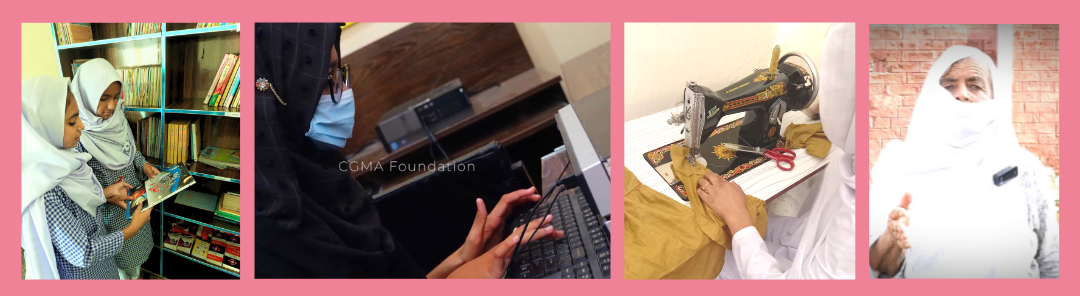
In the remote villages of Soon Valley, Khushab, CGMA Foundation is working to change that reality — ensuring girls have access to safe classrooms, supportive learning environments, and opportunities to continue their studies. Scholarships are awarded to deserving students so they can pursue higher education, college degrees, or vocational training, helping break the cycle of early dropout and limited opportunity.
b) Vocational Training & Skills Development
One of the most transformative aspects of our work is teaching women marketable skills — tailoring, embroidery, handicrafts, agriculture-based crafts, and digital literacy digital literacy
These vocational training programs help women translate their latent talents into independent income, purposeful work, and long-term economic stability.
c) Medical & Health Support
Many rural women, widows, or poor families lack access to basic healthcare. We provide medical support — treatments, checkups, essential medicines — to ease their burdens and keep families healthy, allowing women to focus on growth rather than just survival.
d) Community Welfare Initiatives
Through our community welfare initiatives, CGMA Foundation extends compassion and support to the most vulnerable — providing shelter assistance for widows and nikkah gifts for orphan girls, helping them live with dignity, security, and respect within their communities.
Each of these programs is designed not as an isolated intervention, but as parts of a holistic ecosystem — where education, health, livelihood, and social support feed into each other.
Another first-of-its-kind initiative in this region, the Islamic Community Centre, provides a dedicated space for women to learn ,connect & grow.
The Impact & Vision Forward
The results of these initiatives are already reshaping the lives of women and youth across Soon Valley. CGMA Skill Development Centre Program “She Skills: has emerged as a model of rural empowerment combining technical skills with confidence-building and creativity.
So far, three batches have been successfully completed, training over 100 students. Skill tracks range from stitching and fashion design to basic computer literacy and digital skills, ensuring that women and youth are prepared for both traditional and modern livelihoods. These aren’t just numbers; they represent women who have launched micro-businesses from home, and young people who now see digital access as a bridge to opportunity.
Through CGMA’s initiative
- Girls who would otherwise have dropped out are now completing higher education.
- Women learn trades, earn incomes, and contribute to household finances.
- Communities gradually see shifts in attitudes — valuing women’s skills and rights.
- Rural development becomes more inclusive and sustainable, because women are no longer left behind.
Looking ahead, our vision is to expand to neighboring areas, strengthen partnerships, engage public institutions, and scale our programs so that every rural woman has opportunity, dignity, and voice. Every contribution, big or small, helps us turn potential into empowerment.


